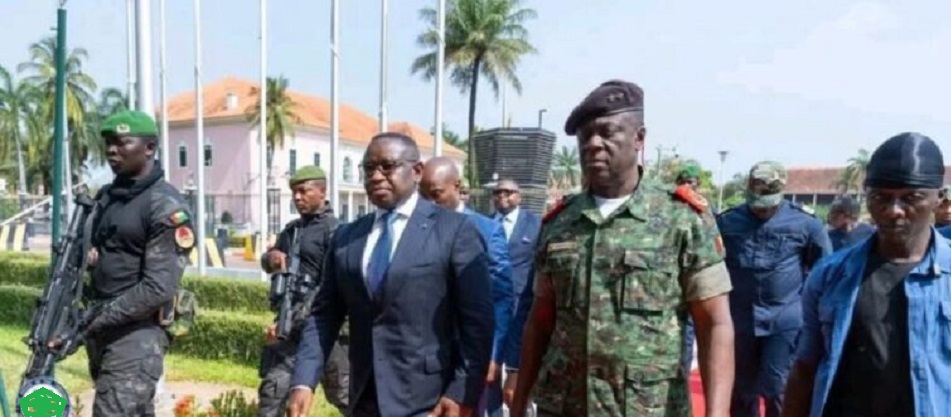
A delegation from the West African regional bloc known as ECOWAS arrived in Guinea-Bissau on Monday for mediation talks with the leaders of a coup over the “complete restoration of constitutional order.”
The ECOWAS mission, led by its chairman and the President of Sierra Leone Julius Maada Bio, arrived as the military government — which seized power last Wednesday — banned all demonstrations, strikes and activities regarded as threats to peace and stability.
In a statement late Sunday, the military authorities also ordered public institutions and ministries to reopen.
During the coup Guinea-Bissau’s President Umaro Sissoco Embalo told French media by phone that he had been deposed and arrested. Embalo has since fled to the Republic of Congo’s capital Brazzaville.
Guinea-Bissau’s military has installed former army chief of staff Gen. Horta Inta-a as the head of the military government, which will oversee a one-year transition period. On Saturday Inta-a appointed a new 28-member government, most of whom are allies of the ousted president.
Nigeria said its President Bola Tinubu has granted protection for Guinea-Bissau opposition candidate Fernando Dias da Costa in response to an ”imminent threat to his life.”
According to a letter to ECOWAS from Nigeria’s Minister of Foreign Affairs on Sunday, Dias da Costa is at the Nigerian embassy in Bissau. The letter requested an ECOWAS troop to provide security.
The day after the coup, ECOWAS said suspended Guinea-Bissau from its decision-making bodies “until the restoration of full and effective constitutional order in the country.” It said its mediation team would travel to Bissau to “engage the leaders of the coup with a view to ensuring the full restoration of constitutional order.”
UN Secretary-General Antonio Guterres expressed grave concern over the events in Guinea-Bissau and condemned the coup. In a statement, Guterres stressed that disregarding “the will of the people who peacefully cast their vote during the Nov. 23 general elections constitutes an unacceptable violation of democratic principles.”
He called for the “immediate and unconditional restoration of constitutional order,” as well as the release of all detained officials, including electoral authorities, opposition leaders and other political actors.
No breakthrough in ECOWAS talks with Guinea-Bissau coup leaders
A high-level delegation from the West African regional bloc known as ECOWAS ended a mediation mission to Guinea-Bissau on Monday with no breakthrough, but pledged to continue talks with coup leaders later this month.
Led by Sierra Leone’s President Julius Maada Bio, the regional bloc traveled to Bissau seeking a return to civilian rule following a military coup last Wednesday.
The junta, which has banned protests and strikes, argued it acted to restore security and stability in the small West African nation. “We’ve had today very fruitful discussions,” said Sierra Leone’s Foreign Minister Timothy Musa Kabba, speaking on behalf of Bio.
“The chair of the authority condemned the coup, and calls for the immediate restoration of constitutional order, which includes allowing the electoral process to a logical conclusion.”
ECOWAS has condemned the coup and called for the reinstatement of President Umaro Sissoco Embaló, who fled to Brazzaville after being detained. In his absence, the military installed former army chief Gen. Horta Inta-a as head of a transitional government that has already appointed a new cabinet, largely composed of allies of the ousted president.
Foreign Minister João Bernardo Vieira, appointed by the junta, said ECOWAS would remain engaged.
“The solution (to returning to constitutional order) is to continue collaborating with ECOWAS,” Vieira said on Monday. “A one-year deadline had been set for the end of the transition, but the issue will be submitted to the ECOWAS Conference of Heads of State and Government on December 14. Depending on this decision or the one that follows from it, we will know what the next steps will be.”
ECOWAS suspended Guinea-Bissau from its decision-making bodies the day after the coup, pending a return to civilian rule.
The United Nations has also condemned the coup, with Secretary-General António Guterres urging the unconditional release of all detained political actors and warning that the will of the people expressed in the November 23 vote must be respected. The military take over happened as the country was waiting for the results of last month’s presidential election.
Guinea-Bissau has endured multiple coups since independence from Portugal in 1974.
Africanews
About the Author