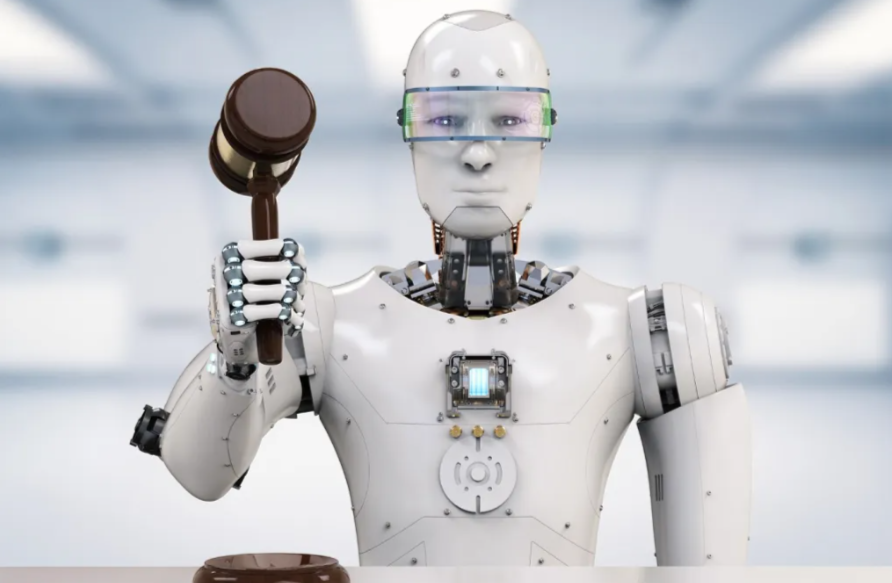
Artificial Intelligence and Justice: Can Machines Help Humanity Deliver Fairness
There are few institutions more sacred to a society than its courts.
Within the quiet walls of a courtroom, lives are altered, freedoms are protected, families are restored, businesses survive or collapse, and sometimes history itself changes direction. A judge does not merely interpret law. A judge carries the immense burden of deciding outcomes that ripple far beyond the written words placed before them. Yet behind every judgment delivered lies an invisible reality few people ever see — the endless files, the thousands of pages of submissions, the exhausting legal research, the weight of precedent, the pressure of time, and the silent burden of knowing that justice delayed often becomes justice denied.
In Nigeria today, our judiciary stands under enormous strain.
Courtrooms are crowded with years of unresolved disputes. Judges work under extraordinary pressure. Cases accumulate faster than decisions can be delivered. Behind every delayed judgment sits a human story — a family waiting for closure, a business trapped in uncertainty, an accused person awaiting fairness, an ordinary citizen losing faith in the system meant to protect them.
This is where Artificial Intelligence enters not as a replacement for justice, but as an ally to those entrusted with delivering it.
Artificial Intelligence offers judges something profoundly valuable: time.
Time reclaimed from reading mountains of repetitive documents. Time saved searching through decades of case law and legal authorities. Time recovered from administrative burdens that quietly consume the very energy needed for sound judicial reasoning.
Imagine a system capable of scanning thousands of legal precedents within seconds, identifying relevant authorities, highlighting contradictions in previous rulings, organising evidence, preparing summaries, transcribing proceedings instantly, and reducing procedural delays that often keep justice waiting endlessly at the door.
But the true power of AI is not speed.
Its deeper value lies in strengthening one of democracy’s most fragile foundations: the rule of law itself.
When judges are supported by intelligent systems that improve consistency, reduce oversight, and create greater efficiency, justice becomes more predictable, more accessible, and ultimately more trustworthy.
Machines cannot replace conscience.
Algorithms cannot replicate wisdom.
Technology cannot understand human suffering.
Only judges possess the moral discernment needed to balance law with humanity.
But when technology removes unnecessary burdens, judges are given something priceless — the freedom to focus entirely on judgment itself.
The future of justice in Nigeria must not be feared.
It must be built.
And perhaps one of the greatest lessons of this technological age is this:
When intelligent machines help human beings deliver justice faster, fairness travels further, trust grows deeper, and the law becomes not merely something written in books…
…but something ordinary people can finally feel working in their lives.
Because when justice moves faster, society breathes easier.
And when the rule of law becomes stronger, a nation stands taller.
Dr. Raphael Christopher ACIARB (UK) LLB(Hons) BL, CIM, PGCE, PGOSDC, FAETC, PTLLS, CELTA.
Senior Member NBA Enugu Branch
About the Author